

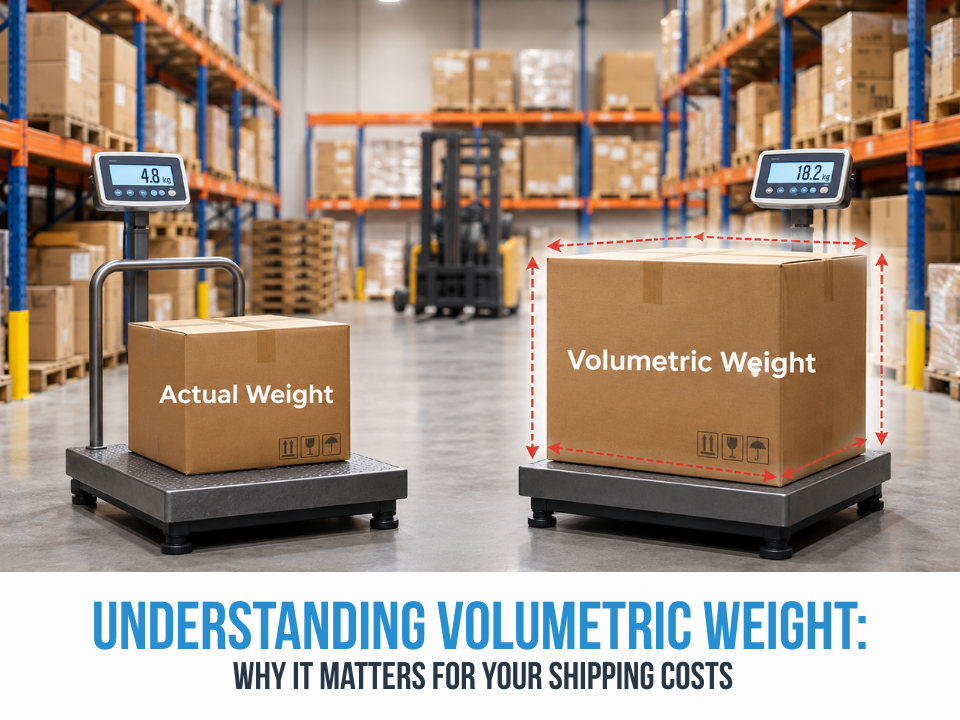
Understanding Volumetric Weight: Why It Matters for Your Shipping Costs
Have you ever shipped something light, like a lampshade or a stack of cushions, and been surprised by how much the shipping actually cost?
If so, you’ve likely run into volumetric weight without realizing it.
The Box That Costs More Than It Weighs
Carriers don’t only charge based on how heavy a package is. They also take into account the space it occupies in a truck, plane or container.
A big but light box may actually be charged on this “dimensional” basis, rather than its actual weight.
So, What Exactly Is Volumetric Weight?
Volumetric weight (also known as dimensional weight) is how carriers can charge you for a shipment based on the volume/ space a package occupies, instead of just its weight.
The concept is pretty simple:
- A truck or cargo plane can only fit so much in it
- A large, lightweight box can occupy space it could otherwise be using to transport something heavier
- To compensate for this, carriers will calculate what a package would weigh if it were dense
- The shipment is then charged on whichever figure is higher: the actual weight or the volumetric weight
Why Volumetric Weight in Shipping Became Common Practice
In earlier years, most carriers charged simply by actual weight. As e-commerce grew and packaging became bulkier (think gift boxes, cushions, or oddly shaped items), carriers found that lightweight but spacious parcels were costing them more than the fees reflected due to limited space availability on aircrafts and trucks. In response, volumetric weight in shipping gradually became standard practice. Today, it appears on most shipping invoices, whether for a single parcel or a larger freight shipment.
Check Out: Reasons Why Businesses Should Use a Dedicated Courier Partner
A Gentle Look at the Volumetric Weight Calculation
The volumetric weight calculation is not difficult once the formula is clear:
(Length × Width × Height) ÷ Volumetric Divisor
A few points worth noting:
- Measurements are usually taken in centimeters
- The divisor depends on the carrier and mode of transport, often 5000 for international courier services or 6000 for air freight as per IATA regulations
- Example: a box weighing 2 kgs and measuring 40 x 30 x 20 cm gives (40×30×20)/5000, which comes to 4.8 kg
- Since the actual weight is lower than this figure, the shipment is usually billed at the higher, volumetric rate (4.8 kgs)
Small Adjustments Can Make a Noticeable Difference
Reducing unnecessary space inside a package can meaningfully lower shipping costs. A few simple habits can help:
- Choosing snug-fitting boxes instead of oversized ones
- Using efficient, lightweight packaging materials
- Flattening items where reasonable before packing
- Avoiding double boxing
- Dismantling the contents, if possible
- Reviewing package dimensions before shipping, especially for frequent shippers
Why This Understanding Can Be Useful
This isn’t a concept limited to logistics professionals. Whether someone runs a small online store or is sending a gift abroad, understanding volumetric weight helps avoid unexpected costs and encourages more thoughtful packing.
If you’re curious to dig deeper into how shipping pricing works, Pace Express has a few useful reads worth checking out.
A Closing Thought
Volumetric weight may sound technical at first, but the idea behind it is simple. Space has a cost, just as weight does. With a little understanding of how it’s calculated, it becomes much easier to pack thoughtfully, manage shipping costs and avoid surprises at checkout.
Pace Express helps to make that experience seamless and reliable from pickup to destination delivery. To enjoy a hassle-free and happy delivery experience, feel free to reach out at +91 84529 40978.